
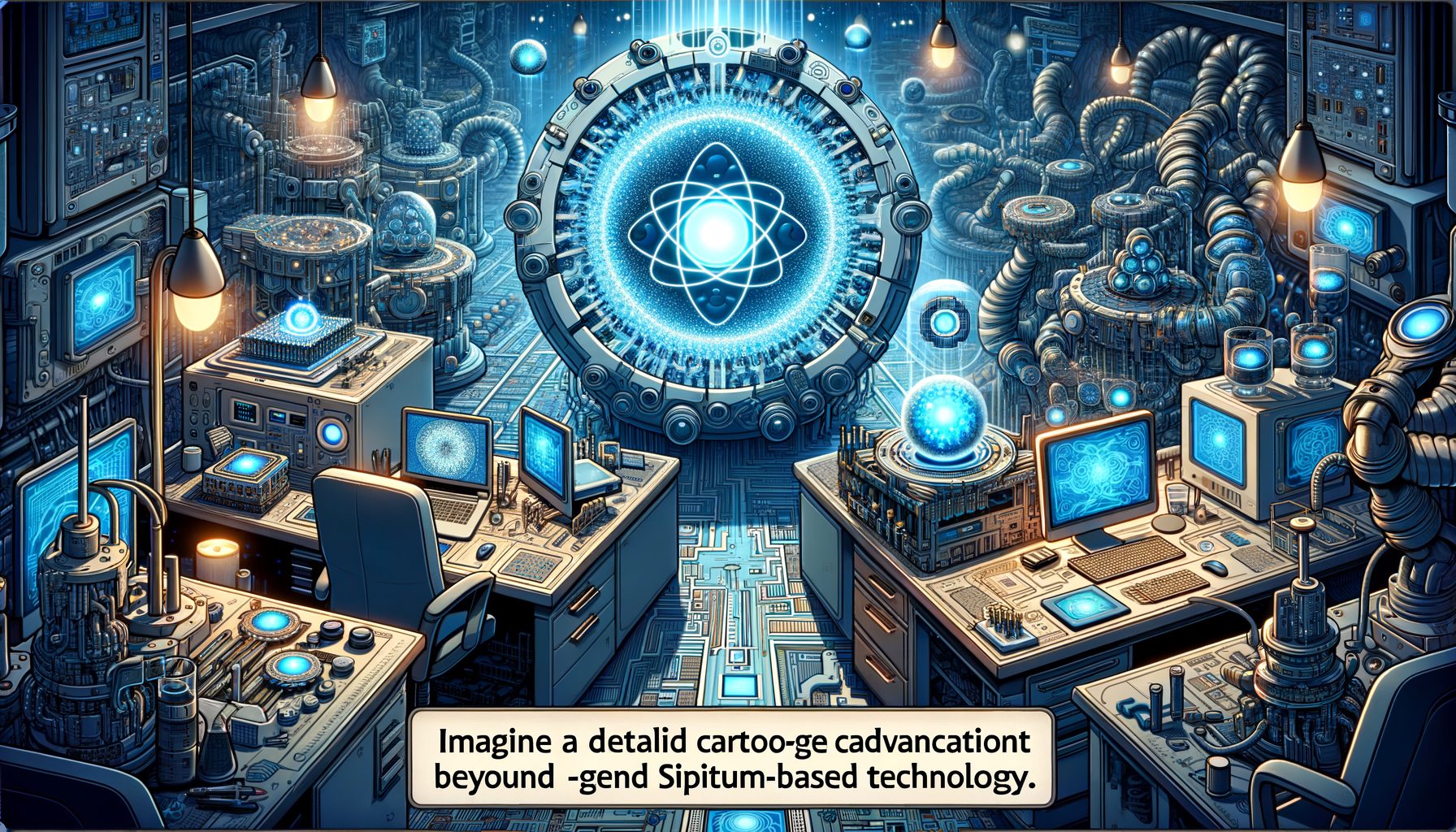
Silicon chips powered the last half-century, yet their runway is shortening. Transistors keep shrinking while power, heat, and cost climb. Many teams feel the wall today: more data, more AI, and weaker returns from classical scaling. Next-Gen Quantum Chipsets aim to push beyond those limits by harnessing superposition and entanglement to accelerate specific classes of problems. In the pages ahead, you’ll see what that actually means, which technologies lead, and how to get hands-on without taking risky bets.
The Real Problem: Silicon Is Hitting Physical, Economic, and Energy Walls
Moore’s Law slowed to a crawl, and the end of Dennard scaling turned extra transistors into extra heat. Even with extreme ultraviolet lithography, 3D packaging, and chiplet architectures, cost per performance now yields diminishing returns for CPUs and GPUs. For AI, model parameters and context windows outpace memory bandwidth; interconnects and energy per operation increasingly set the ceiling on training efficiency. Data pipelines swell faster than exact computation can be delivered within latency and power budgets. The result is familiar: rising compute bills, longer time-to-insight, and sustainability concerns.
In that context, next-gen quantum chipsets matter. They aren’t “faster CPUs,” but accelerators tuned to particular structures—combinatorial optimization, selected quantum chemistry simulations, and linear-algebra transforms. Where classical hardware stalls under state-space explosion (for example, simulating molecules with correlated electrons), qubits encode complex probability amplitudes more compactly.
A talent and tooling gap widens the challenge. Many teams still equate “quantum” with sci‑fi, or assume it’s only about breaking cryptography. In practice, quantum will complement—not replace—classical. The near-term edge comes from a hybrid flow: classical pre-processing, a quantum kernel, then classical post-processing. Organizations that learn to frame problems for this hybrid model will see compounding benefits as hardware clears error-correction thresholds. The practical question isn’t “Should I buy a quantum computer?” Well, here it is: “Which workload patterns could benefit, and how do I build a low-risk path to readiness while silicon stalls?”
What Makes Next-Gen Quantum Chipsets Different (and Why That Matters)
Quantum chipsets operate on qubits rather than bits. A bit is 0 or 1; a qubit can exist in a complex superposition of states. Entanglement correlates qubits in ways classical systems cannot efficiently model. Together, these properties let certain algorithms—like phase estimation for chemistry or amplitude amplification for search—scale differently from classical approaches.
Raw qubits, however, are noisy. Devices today exhibit finite coherence times (how long a qubit preserves information) and non‑zero gate errors (how often operations fail). Hence the field separates NISQ hardware (Noisy Intermediate-Scale Quantum) from future fault‑tolerant systems. To bridge the gap, vendors emphasize:
– Materials and fabrication: Superconducting qubits (aluminum/niobium on silicon) benefit from mature microfabrication and rapid gate speeds. Trapped ions offer long coherence with laser-controlled gates. Neutral atoms and photonics add room‑temperature or network‑friendly advantages.
– Control stacks: Cryogenics, microwave control, photonic routing, and real-time feedback electronics are being integrated via chiplets and 3D packaging. Rack‑scale controls are collapsing into compact modules to boost stability and density.
– Error suppression and correction: Dynamical decoupling, zero‑noise extrapolation, and probabilistic error cancellation can reduce effective error on small circuits. Longer term, error‑correcting codes (for example, surface codes) will assemble logical qubits from many physical ones, enabling deep circuits for impactful algorithms.
Crucially, next‑gen chipsets are built for hybrid use. CPUs/GPUs handle orchestration, optimization loops, and variational updates; the quantum chipset executes compact but pivotal kernels. What’s interesting too: in the right circuit, even a handful of high‑fidelity two‑qubit gates can shift scaling behavior on a targeted subproblem. It is not a universal speedup; instead, it’s selective acceleration where structure matches quantum strengths—the kind of leverage organizations need as classical scaling slows.
Qubit Technologies and Their Trade-Offs
“The best quantum chipset depends on your workload” isn’t a dodge—it’s engineering reality. Each modality balances coherence, speed, connectivity, temperature, and manufacturability differently. By grasping those trade‑offs, you can choose the right cloud back end, SDK, and algorithm family for pilots.
Below is a high‑level snapshot. Values are approximate and evolve quickly; consult vendor documentation for current specifications.
| Qubit Modality | Typical Coherence | Gate Speed | Operating Conditions | Notable Strengths | Considerations |
|---|---|---|---|---|---|
| Superconducting | ~50–300 μs | ~10–100 ns (1- and 2-qubit) | ~10–20 mK (dilution fridge) | Fast gates; advanced fabrication; strong ecosystem | Cryogenics; crosstalk; scaling control lines |
| Trapped Ions | ~1–10+ s | ~10–200 μs | Room temp UHV with lasers | Long coherence; all-to-all connectivity in small chains | Gate times slower; scaling chains and shuttling |
| Neutral Atoms | ~0.5–5 s | ~1–10 μs (Rydberg gates) | Room temp UHV, optical tweezers | Scalable arrays; flexible connectivity | Laser stability; calibration complexity |
| Photonic | Limited by loss rather than time | Light-speed operations | Room temp; integrated optics | Networking; repeaters; potential for on-chip optics | High-efficiency sources/detectors; error correction overhead |
| Spin Qubits (Silicon/GaAs) | ~100 μs–10 ms (with isotopic purification) | ~ns–μs | mK–K (varies) | CMOS compatibility; small footprints | Uniformity; controllability at scale |
From an engineering lens, speed governs algorithm depth, coherence drives error rates, and connectivity shapes compilation efficiency. For instance, superconducting devices excel at rapid, near‑term variational circuits, while trapped‑ion systems may run deeper circuits thanks to longer coherence and broad connectivity. Neutral atoms target high qubit counts with flexible geometry. Photonic platforms look promising for quantum networking and linear‑optical tasks. Spin qubits, once tamed, could exploit CMOS flows for dense, low‑power arrays.
Public roadmaps indicate steady progress: higher two‑qubit fidelities, larger qubit counts, better compilers, and stronger error‑mitigation toolchains. For up‑to‑date milestones and papers, see IBM Research’s quantum pages (IBM Quantum), Google Quantum AI’s publications (Google Quantum AI), and overviews at Nature and arXiv.
Practical Use Cases You Can Try Today
Fully fault‑tolerant machines are still in development, yet several useful paths are available now—especially with hybrid algorithms and problem‑specific embeddings:
– Chemistry and materials: Variational quantum eigensolver (VQE) methods approximate ground‑state energies for small molecules or active spaces. Even modest gains can accelerate lead triage in drug discovery or catalysis. Prototype with open‑source toolkits and validate against classical coupled‑cluster methods on subsets.
– Optimization: Portfolio rebalancing, routing, and scheduling can map to Ising or QUBO forms. Quantum Approximate Optimization Algorithm (QAOA) and related heuristics may yield better solutions or better scaling on structured instances. Teams often iterate: establish a classical meta‑heuristic baseline, insert a quantum kernel, then compare solution quality, wall‑clock, and energy use.
– Machine learning: Quantum kernels and feature maps can enrich classical models on small, noisy datasets by transforming feature spaces. Frameworks like PennyLane and TensorFlow Quantum make it straightforward to add quantum layers and run on simulators or real hardware to measure generalization.
– Secure experimentation: Exploration can be safe and isolated. Use cloud services offering circuit simulators and limited‑time hardware access. Keep experiments reproducible: fix seeds, log circuit depth and two‑qubit counts, and track mitigation techniques. Then this: always compare against strong classical baselines to avoid cargo‑cult enthusiasm.
To get started quickly: (1) pick a toy instance of a real problem (for example, a 20‑asset subset for portfolio optimization), (2) encode it with an SDK such as Qiskit, Cirq, or PennyLane, (3) run on a simulator first, then on a cloud quantum back end via AWS Braket or Azure Quantum, and (4) report metrics and iterate. That playbook builds intuition and credibility with stakeholders.
Building a Quantum-Ready Tech Stack
Organizations need not “go all in” to prepare. A quantum‑ready stack should be incremental, hybrid, and pragmatic:
– Workload triage: Scan your portfolio for quantum‑friendly structures—combinatorial optimization, simulation of quantum systems, linear‑algebra cores, or kernel‑based ML. Tag each with tractable toy instances and clear success metrics.
– Tooling and skills: Standardize on one SDK to start (Qiskit or Cirq are popular, PennyLane for ML). Adopt a versioned environment with containers and CI so experiments reproduce across simulators and different hardware back ends.
– Hybrid orchestration: Wrap quantum circuits with classical optimizers (for example, COBYLA, SPSA, gradient‑based). Automate parameter sweeps and error‑mitigation toggles. Keep shots, depth, and two‑qubit counts on strict budgets to control cost and variance.
– Benchmarking discipline: Always evaluate against strong classical baselines (simulated annealing, Gurobi‑like solvers, tensor networks for small systems). Track three metrics: solution quality (or chemical accuracy), time‑to‑solution, and energy consumed. Publish internal “fair fight” comparisons to guide roadmap decisions.
– Security and compliance: Begin quantum‑safe crypto planning now. Post‑quantum cryptography (PQC) standards from NIST are available; see NIST PQC. Inventory cryptographic dependencies, pilot hybrid key exchange, and set migration guidelines independent of when fault‑tolerant machines arrive.
– Partnerships: Tap university labs, vendor programs, and cloud credits. Many providers offer sandboxes, tutorials, and reference circuits. By combining internal domain knowledge with external quantum expertise, you shorten the learning curve and keep experiments tied to business value.
Q&A: Quick Answers to Common Questions
Q1: Will quantum chips replace GPUs?
A1: No. Quantum chipsets are accelerators for specific problem structures. The winning architecture is hybrid: CPUs/GPUs handle data‑heavy tasks; quantum executes targeted kernels where scaling advantages exist.
Q2: When will fault‑tolerant quantum computers arrive?
A2: Timelines vary by modality and roadmap. Many experts expect a multi‑year path to first logical qubits with practical depth. Meanwhile, error mitigation on NISQ devices and scalable control electronics are increasing useful capacity.
Q3: Is my data safe if I use quantum cloud services?
A3: Major providers follow standard cloud security practices. For sensitive workloads, anonymize or generate synthetic datasets for experimentation. Begin PQC planning now to future‑proof data‑in‑transit and stored archives.
Q4: What’s the fastest way to get hands‑on?
A4: Start with a toy version of a real problem, implement it in an SDK like Qiskit or Cirq, validate on a simulator, then run on a small quantum device through AWS Braket or Azure Quantum. Compare results to strong classical baselines and iterate.
Conclusion: Your Next Step Beyond Silicon Limits
We began with the core problem: classical silicon is straining under physical, economic, and energy constraints just as data and AI demand more. Next‑gen quantum chipsets won’t magically solve every computation, yet they offer targeted leverage where classical methods struggle—quantum chemistry, structured optimization, and certain learning kernels. You’ve seen how qubit technologies trade off coherence, speed, and scalability; how hybrid workflows extract value now; and how to assemble a quantum‑ready stack without reckless bets. The message is simple: you don’t need fault tolerance to start learning, measuring, and preparing.
Act now with three concrete steps: (1) shortlist two candidate workloads and define win conditions (accuracy, time, or energy), (2) prototype them with an SDK on a simulator and at least one hardware back end via a cloud platform, and (3) benchmark against strong classical baselines and publish the results internally. That cycle builds credibility, sharpens intuition, and positions your team to capture gains as hardware and compilers improve. What’s interesting too: bring security teams in early to plan a phased PQC migration, and cultivate partnerships with vendors and universities to stay on the leading edge without overcommitting capital.
Innovation favors those who prepare while others wait. If you start today, your organization will be ready to plug quantum kernels into production workflows the moment error rates and logical qubits cross critical thresholds. Share this article with a colleague, pick a pilot problem this week, and book an hour to sketch your first experiment plan. The frontier is open—why not be the team that steps beyond silicon limits first? What small, meaningful quantum experiment could you stand up in the next 30 days?
Sources and Further Reading
– IBM Quantum Research: https://research.ibm.com/quantum
– Google Quantum AI: https://quantumai.google
– AWS Braket Service: https://aws.amazon.com/braket/
– Microsoft Azure Quantum: https://azure.microsoft.com/en-us/products/quantum
– NIST Post-Quantum Cryptography: https://csrc.nist.gov/Projects/post-quantum-cryptography
– Nature Quantum Computing Collection: https://www.nature.com/collections/hhcfdbbnhb
– arXiv Quantum Physics: https://arxiv.org/list/quant-ph/recent