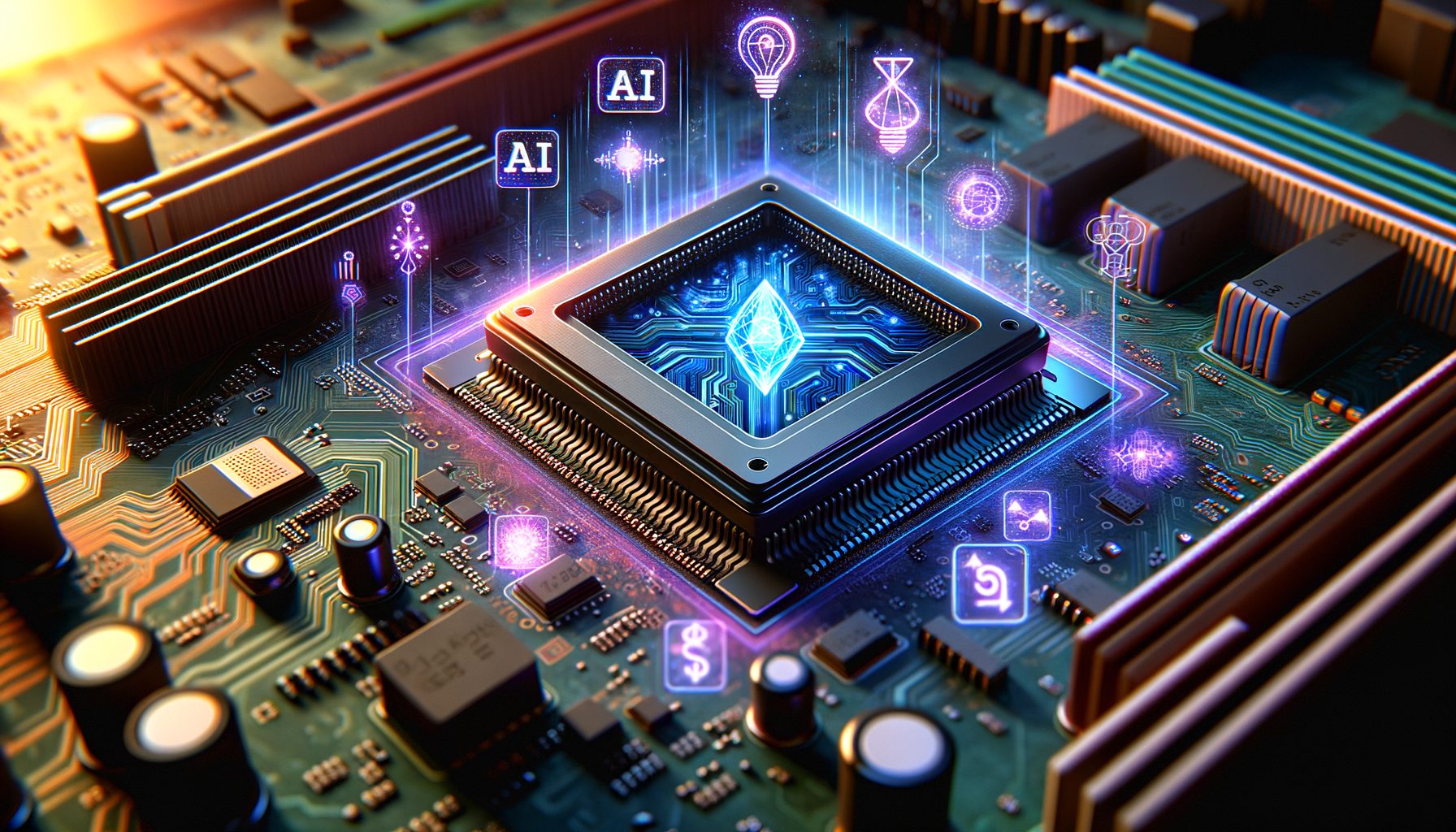
AI-powered chipsets are now the heart of modern computing, from data centers training large language models to smartphones running on-device generative AI. The problem for most readers is clear: the hardware landscape shifts faster than budgets, skills, and product roadmaps. Costs are rising, energy is limited, and every week brings a new acronym. In this guide, we cut through the noise with plain, practical guidance: what matters, what’s next, and how to choose wisely. If you need a single, trustworthy overview to plan your next upgrade, feature launch, or job move, you’re in the right place.
Why AI-powered chipsets matter right now
AI is only as useful as the hardware that runs it. The rise of transformer models brought a step-change in compute needs: more matrix math, more memory bandwidth, and more parallelism. That’s why data centers deploy accelerators, edge devices add neural processing units (NPUs), and laptops ship with dedicated AI blocks. Product teams feel the pressure as cost per inference, latency, data privacy, and the pace of model updates collide. IT leaders watch energy budgets and worry about vendor lock-in. Creators and researchers chase training speed and portability across ecosystems.
The most tangible shift is simple: users expect AI everywhere. Speed matters. Privacy, too. Chatbots must respond in under a second. Photo tools need instant background removal. Transcription should run offline on a phone. Experiences like these are possible because AI-powered chipsets are optimized for tensor operations, quantized math (like INT8/INT4), and fast memory access. In data centers, GPUs and AI accelerators pair compute with high-bandwidth memory (HBM) to feed models efficiently. At the edge, NPUs run compact models while sipping power, protecting privacy by keeping data on-device. Between those extremes, cloud and edge cooperate through smart routing—running heavy models in the cloud and lightweight personalization locally.
Another urgency driver is energy. Training large models can consume megawatt-scale power, and even inference workloads now dominate AI spend for many companies. The International Energy Agency has warned that data center electricity demand is set to grow significantly by 2026, with AI a major contributor. As a result, efficiency—not just raw speed—gets elevated to a board-level metric. Hardware-aware techniques like sparsity, operator fusion, and mixed precision aren’t niche tricks anymore; they directly translate to lower bills and greener footprints. In short, AI chipsets matter because they make AI useful, affordable, and responsible at the scales we now demand.
Key trends shaping the AI hardware landscape
Five trends define how AI-powered chipsets are evolving: edge AI, memory-centric design, chiplet architectures, open instruction sets, and software portability.
First, edge AI is moving from novelty to default. Phone and PC NPUs in the 40–60 TOPS class (INT8) are now common, enabling local summarization, translation, and image generation without a network connection. The result: lower latency and better privacy. Developers increasingly ship dual-mode apps—a small on-device model backed by a larger cloud model when needed. Users get smoother experiences, while cloud bills come down.
Second, memory bandwidth is king. Modern models are often limited by how fast weights and activations can move, not just by raw FLOPS. High-bandwidth memory (HBM3 and HBM3e) can deliver multiple terabytes per second at the package level, and roughly around one terabyte per second per stack in cutting-edge parts. What’s interesting too: recent accelerators pair vast HBM capacity with specialized interconnects to avoid starving compute cores. Expect continued innovation in stacked memory, in-package optics, and compression-aware kernels.
Third, chiplet-based designs are unlocking performance and yield gains. Instead of one gigantic die, vendors combine multiple smaller dies—some dedicated to compute, others to memory or I/O—within a single package. The modular approach improves supply flexibility and allows vendors to mix process nodes. It also opens opportunities for custom accelerators tuned to specific workloads like recommendation systems or diffusion models.
Fourth, the ISA landscape is diversifying. ARM maintains a strong position in mobile and increasingly in client PCs and servers, while RISC-V enables open, customizable designs—especially for low-power edge AI and domain-specific accelerators. Competition like this should drive faster innovation and cost pressure across segments. Meanwhile, x86 CPUs integrate NPUs to balance general-purpose tasks with AI offload.
Finally, software portability is improving. Frameworks and runtimes like PyTorch, TensorFlow, ONNX Runtime, and vendor stacks (CUDA, ROCm, oneAPI/SYCL) are getting better at targeting multiple backends with consistent performance. Quantization-aware training, distillation, and compilers like TVM help developers squeeze every watt, regardless of the underlying silicon. Benchmark bodies such as MLCommons standardize measurements so teams can compare apples to apples.
Well, here it is—a compact snapshot of how these trends show up in real products and metrics.
| Trend | What it means | Typical metric | Real-world examples |
|---|---|---|---|
| Edge AI NPUs | On-device inference for privacy and low latency | ~40–60 INT8 TOPS (phones/PCs) | Smartphone NPUs, PC NPUs in new laptops |
| HBM-centric accelerators | Feed large models with massive bandwidth | 4–5+ TB/s package bandwidth | Data center GPUs with HBM3/HBM3e |
| Chiplets | Modular dies for compute, memory, and I/O | Better yield; flexible scaling | Multi-die GPUs/CPUs and AI accelerators |
| Open ISAs (RISC-V) | Custom accelerators and freedom to tailor | Energy-efficient ops per watt | RISC-V AI cores for edge devices |
| Portable software | One model, many backends | ONNX/TensorRT/ROCm compatibility | Cloud-to-edge deployments |
For deeper dives, see MLPerf results for objective comparisons, and vendor docs from NVIDIA, AMD, Intel, Arm, and RISC-V groups, which explain how these trends turn into real gains for both training and inference.
Predictions for the next 3–5 years
On-device generative AI will become mainstream. Expect phones and PCs to run multimodal assistants locally, handling tasks like meeting summaries, image editing, and translation without sending data to the cloud. That shift won’t eliminate cloud AI, but it will reshape it: larger models will remain in the cloud for complex reasoning, while everyday interactions happen on-device for speed and privacy. Then this: developers will design apps to fluidly switch between the two.
Memory will outpace compute as the bottleneck for more workloads. Vendors will prioritize higher memory bandwidth and capacity, plus smarter caching and sparsity-aware kernels. We will see broader use of compressed weights, 4-bit inference for select layers, and distillation into compact student models. Hybrid memory systems—combining HBM with faster interconnects or near-memory compute—will become a defining feature of top-tier accelerators.
Chiplets will go mainstream across price tiers. Consumer-grade AI GPUs and NPUs will benefit from mix-and-match dies that optimize yield and let manufacturers iterate faster. In enterprise settings, chiplet-based designs will enable modular upgrades—swapping in more memory or adding domain-specific accelerators without changing the whole system. This modularity could shorten product cycles and reduce TCO for organizations that refresh hardware frequently.
Competition among ecosystems will intensify, but software will narrow the gap. While vendor-specific stacks will remain powerful, open standards like ONNX and cross-vendor compilers will make it easier to port workloads. Good news for buyers: fewer dead ends and more negotiating leverage. Expect MLPerf to expand coverage for generative AI tasks, giving clearer signals for inference at scale versus power-constrained edge use.
Sustainability will become a top buying criterion. As data center energy use grows, enterprises will track joules per token and emissions per inference as closely as latency. Expect hardware labels and procurement policies that score systems on performance-per-watt and lifecycle impact. Governments and industry consortia are likely to push for transparent reporting. AI leaders who optimize for efficiency will both save money and meet regulatory expectations.
Finally, expect AI developers to look more like performance engineers. Model choices will be made with hardware in mind: attention variants tuned for cache, KV caching to minimize memory traffic, and operator fusion to cut overhead. The winners will be teams that pair strong ML skills with hardware-aware engineering.
How to choose or build for AI chipsets today
Start with the workload, not the logo. Write down your top tasks: are you training from scratch, fine-tuning, or mostly doing inference? What are your target latencies and batch sizes? How sensitive is your data? Those answers determine whether you need cloud accelerators, on-prem systems, or edge NPUs. For example, a customer support assistant that must answer in under 500 ms may require local inference with a quantized model, while a weekly retraining pipeline belongs in the cloud.
Map metrics to constraints. For inference, prioritize memory capacity and bandwidth first, then compute. Check if your model fits in-device memory at the chosen precision (FP16, INT8, or 4-bit). For edge devices, focus on TOPS-per-watt and sustained performance under thermal limits. For training and heavy fine-tuning, look at interconnect bandwidth between chips, HBM capacity, and software ecosystem maturity. Remember that availability and queue times matter—some accelerators are simply hard to get.
Evaluate the software stack that you can realistically support. CUDA remains dominant for some GPU workflows; ROCm has matured quickly; oneAPI/SYCL offers portability; ONNX Runtime and TensorRT/TensorRT-LLM can deliver big inference wins. If your team relies on Python-first workflows, confirm that your target hardware has solid PyTorch and TensorFlow support with up-to-date kernels. Test quantization toolchains and check for operator coverage in your models (e.g., attention variants, flash attention, grouped convs).
Prototype before you commit. Use public benchmarks such as MLPerf for baseline expectations, then run your own end-to-end tests with realistic prompts, batch sizes, and observability. Include energy and cost metrics in your dashboards—dollars per million tokens, joules per inference, and time-to-first-token. Pilot an on-device build early if edge is in scope; surprises usually come from memory limits and thermal throttling, not theoretical TOPS.
Plan for portability and vendor diversity. Package your models in ONNX where possible, maintain quantized and full-precision variants, and keep a reference container that can target multiple accelerators. That hedges supply risks and gives you room to negotiate. For startups, managed services can speed time to market; for enterprises, hybrid deployments (cloud burst + on-prem + edge) often provide the best mix of control and scalability.
Finally, don’t forget MLOps. Hardware-aware CI pipelines that test multiple precisions, automate calibration, and validate accuracy drift will save you months. Treat model cards as living documents that include device targets, precision, and expected latency. That’s how AI features ship on time and stay performant across the hardware you own today—and the hardware you will buy tomorrow.
Quick Q&A
Q: Do I need a GPU, an accelerator, or an NPU?
A: Match the tool to the job. Use data center GPUs/accelerators for training and high-throughput inference; use NPUs for on-device, low-latency, and privacy-sensitive tasks. Many stacks combine all three across cloud, on-prem, and edge.
Q: What does TOPS actually tell me?
A: TOPS is a rough maximum for integer operations. It does not guarantee real-world speed. Memory bandwidth, kernel quality, and model precision often matter more. Always test your exact workload.
Q: Is 4-bit inference production-ready?
A: Yes for many generative workloads, especially with mixed-precision strategies and calibration. Validate accuracy on your data, and keep a fallback (INT8/FP16) for edge cases.
Q: Will on-device AI replace cloud AI?
A: No—each complements the other. Expect a split where everyday, private, low-latency tasks run locally, while complex reasoning and heavy training stay in the cloud.
Q: How do I compare vendors fairly?
A: Use MLPerf for a baseline, then run your own end-to-end tests with your prompts, sequences, and latency targets. Track cost, energy, availability, and software support—not just peak specs.
Conclusion
The AI hardware story is bigger than any single chip. We saw why AI-powered chipsets matter now: they turn ambitious models into fast, private, and affordable user experiences. We unpacked five defining trends—edge NPUs, memory-first design, chiplets, open ISAs, and portable software—and explored how they shape real products. We projected a near future where on-device assistants are normal, memory sets the pace, ecosystems compete, and sustainability becomes a must-have metric. Finally, we turned strategy into action: profile your workload, map metrics to constraints, validate the software stack, prototype with real tests, and plan for portability.
Your next step is simple and concrete. Pick one target use case—a chatbot, a vision pipeline, or a laptop feature—and benchmark it on two different hardware stacks this week. Measure latency, cost, and energy. Try an on-device build if you haven’t yet. Package your model in ONNX, test INT8 or 4-bit, and record accuracy and speed. Use these findings to draft a 90-day hardware roadmap: what you can ship today, what you can pilot next quarter, and what you should budget for next year.
If you act now, you’ll move faster, spend less, and deliver better user experiences. The hardware is ready, the software is catching up, and the best practices are known. Turn uncertainty into advantage by testing early and building for portability. The organizations that pair ambition with measurement will lead the next wave of AI products. Are you ready to run your first benchmark and see what your future hardware stack can really do?
Helpful links
PyTorch and TensorFlow
NVIDIA Data Center, AMD Accelerators, Intel Platforms
Sources
International Energy Agency, “Data centres and data transmission networks” (2024 update): https://www.iea.org/reports/data-centres-and-data-transmission-networks
MLCommons, MLPerf Benchmarks: https://mlcommons.org/en/mlperf/
ONNX and ONNX Runtime: https://onnx.ai/
NVIDIA Data Center Platform: https://www.nvidia.com/en-us/data-center/
AMD Data Center Accelerators: https://www.amd.com/en/products/accelerators.html
Arm Architecture Resources: https://www.arm.com/
RISC-V International: https://riscv.org/
Hugging Face Model Hub and Inference Resources: https://huggingface.co/