
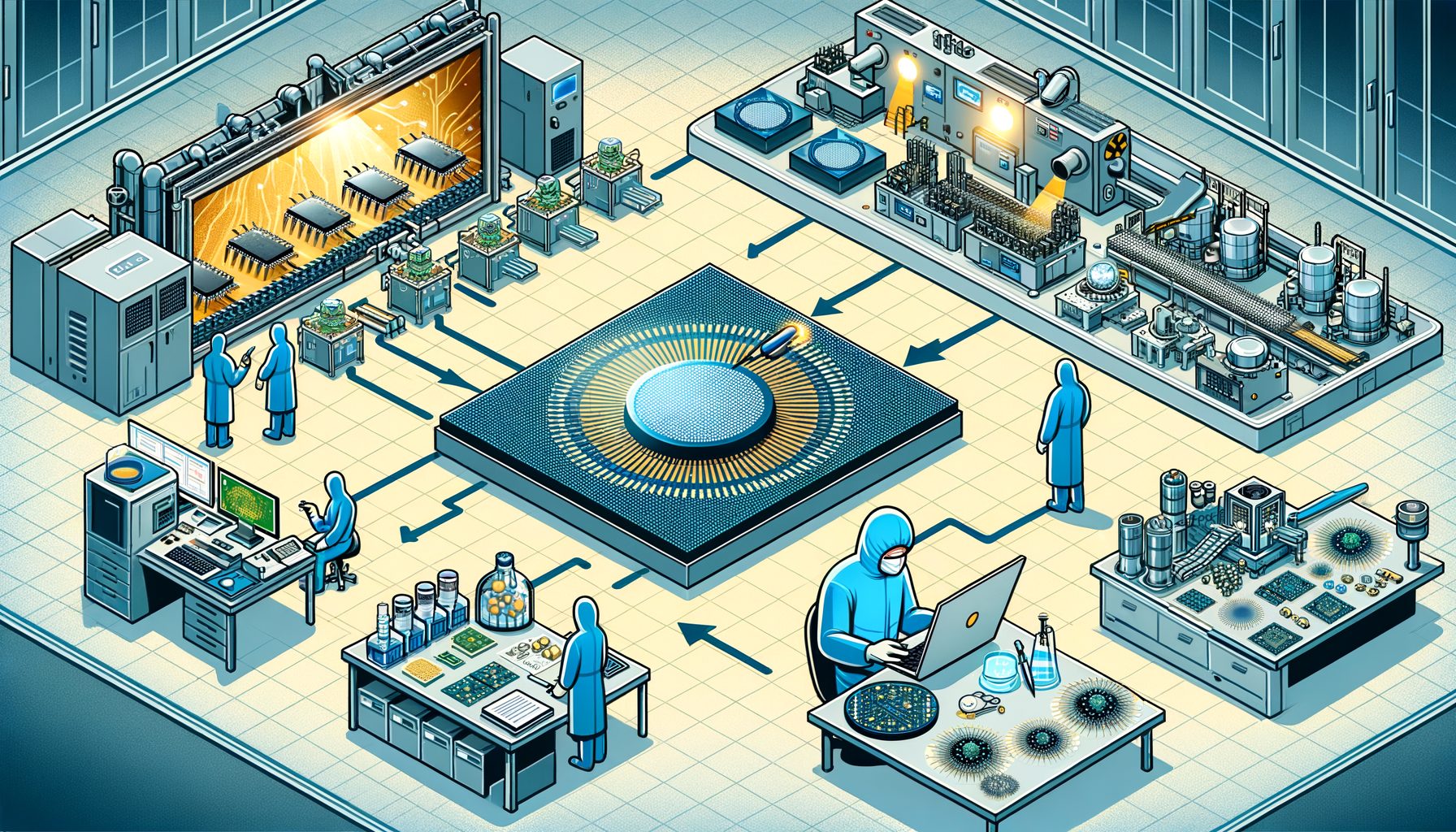
You’ve probably heard terms like 7 nm, 5 nm, or 3 nm tossed around. But what do those fabrication nodes actually mean for the chips in your phone, laptop, car, or data center? The big snag is simple: node names no longer map cleanly to a physical size, which makes it harder for engineers, founders, and tech-savvy consumers to choose wisely. In the pages below, we demystify fabrication nodes, explain why they matter, and hand you a practical playbook to pick the right process for performance, power, and cost—without drowning in buzzwords.
What a Fabrication Node Really Means Today
A generation ago, a “process node” roughly matched a critical transistor dimension, like gate length. That era is over. Today, node labels are marketing-friendly signposts for a technology generation rather than literal nanometers. A “3 nm” chip does not contain 3 nm transistors. Rather than a ruler number, modern nodes are defined by a blend of metrics—contacted poly pitch (CPP), minimum metal pitch (MMP), transistor density, device architecture (planar, FinFET, or GAAFET), interconnect stack design, and yield maturity.
Two ideas dominate the modern definition. First, density: newer nodes usually pack more transistors per square millimeter, boosting compute and feature count at a given area. Second, performance and power: device structures and materials evolve to sustain higher speed at lower voltage, aiming to cut both dynamic and leakage power. Yet scaling is uneven. Logic density often outpaces SRAM, and interconnect resistance can become a bigger bottleneck than the transistors themselves.
Each foundry balances these trade-offs differently, so “same-named” nodes are not apples-to-apples across companies. For instance, a 5 nm-class process at one foundry may deliver density similar to a 7 nm+ process at another, depending on design rules and libraries. That’s why engineers compare contacted gate pitch and metal pitches—or rely on independently measured transistor densities—rather than labels alone. Resources like WikiChip’s comparisons and foundry technical briefs help decode real capabilities behind the names.
Advanced lithography paved the way for recent nodes as well. Extreme ultraviolet (EUV) lithography trims the number of complex multi-patterning steps required in deep ultraviolet (DUV), typically improving pattern fidelity and yield. Even so, EUV doesn’t fix everything: wiring resistance, via reliability, and heat dissipation still challenge designers at the leading edge. In short, a node name is shorthand for a bundle of innovations and compromises—not a measurement with a ruler.
How Nodes Impact Power, Performance, and Cost
Ask “Is a new node worth it?” and you’re really asking about PPA+C—power, performance, area, and cost. A fresh node can cut dynamic power (P ≈ C × V² × f) by lowering capacitance and, at times, supply voltage. Yet voltage scaling has slowed, and leakage can rise as devices shrink. Performance gains come from better device physics (shorter effective channels, new transistor structures) and improved interconnect, though wiring delay increasingly caps top-line frequency. Area typically shrinks, but not uniformly across logic, SRAM, analog, or I/O—an asymmetry that matters more than a headline density figure.
Cost warrants its own spotlight. Mask sets at leading nodes can run into the tens of millions of dollars. EUV scanners rank among the most expensive machines ever built, and wafers at 5 nm- and 3 nm-class nodes cost far more than those at 16 nm or 28 nm. On top of manufacturing, design costs rise with stricter rules, deeper verification, tougher sign-off, and the need for specialized teams. The good news: if your chip ships in high volume, amortized performance-per-dollar or power-per-inference at an advanced node can be unbeatable. For lower volumes or analog-heavy designs, mature nodes often win on economics and time-to-market.
Yield is the wild card tying PPA to cost. Early in a node’s life, defect densities tend to be higher, so big dies may see lower yields and higher cost per good chip. Over time, yields usually improve as the process matures. That reality makes “node timing” strategic: first movers can capture performance advantages; fast followers often get better cost and higher yield a year later. For many products—especially automotive or industrial with long lifecycles—stability and qualification on a slightly older node are worth more than chasing the newest label.
Bottom line: a node is a multi-dimensional trade. Ask whether it meaningfully improves your workload’s energy efficiency and latency at a sustainable cost—not simply whether the number is smaller.
From 90 nm to 2 nm: The Technologies That Made It Possible
Several breakthroughs underpin scaling across generations. Around 45/32 nm, high-k metal gate (HKMG) replaced polysilicon gates to cut leakage and enable further voltage scaling. At 22/16/14 nm, planar transistors yielded to FinFETs—3D fins that improve channel control and reduce short-channel effects. EUV lithography entered high-volume manufacturing at 7 nm and 5 nm, reducing multi-patterning complexity on critical layers. Next up: gate-all-around FETs (GAAFETs—nanosheets or nanowires), which further tighten electrostatics, arriving in volume at the 3 nm and 2 nm timeframes depending on the foundry.
Wires matter just as much. As dimensions shrink, resistance and capacitance rise, hurting delay and power. Foundries answered with new materials, barrier schemes, air gaps, and taller interconnect stacks. Looking ahead, backside power delivery networks (BSPDN) and buried power rails can slash IR drop and free routing resources on the front side. High-NA EUV is slated to push patterning below current EUV limits, supporting future 2 nm-class nodes and beyond. Meanwhile, complementary FETs (CFETs—stacking nFET over pFET) are being explored to squeeze more performance per footprint later this decade.
The table below offers an indicative snapshot. Values vary with libraries, design styles, and foundry choices; treat them as ranges, not absolutes.
| Node (Label) | First HVM Year (Approx.) | Typical Device | Patterning | Indicative Logic Density (MTr/mm²) | Example Ecosystem |
|---|---|---|---|---|---|
| 28 nm | 2011–2012 | Planar CMOS | DUV, multi-patterning | 3–8 | TSMC, Samsung |
| 16/14 nm | 2014–2016 | FinFET | DUV, heavy multi-patterning | 25–40 | TSMC, Samsung, Intel |
| 7 nm | 2018–2019 | FinFET | DUV + EUV (partial) | 90–110 | TSMC N7/N7+, Samsung 7LPP |
| 5 nm | 2020–2021 | FinFET | Full EUV (more layers) | 150–180 | TSMC N5/N4, Samsung 5LPE |
| 3 nm | 2022–2023 | FinFET→GAAFET (varies) | Expanded EUV | 200–250+ | TSMC N3 family, Samsung 3GAE/3GAP |
| 2 nm (roadmap) | 2025–2026+ | GAAFET (nanosheets) | EUV + early high-NA | 250–300+ (projected) | TSMC, Samsung, Intel |
For deeper dives, see ASML’s EUV overview (ASML) and imec’s logic scaling updates (imec). WikiChip’s independent tracking is a valuable cross-check across vendors (WikiChip).
Choosing the Right Node in Practice
Not every product needs 3 nm. The “right” node blends business and engineering realities: workload, budget, and timeline. Let this checklist guide the trade:
- Pin down your bottleneck—compute, memory bandwidth, or I/O. If memory-bound, a node shrink may help less than reworking cache or raising DRAM bandwidth.
- Set concrete PPA targets: watts, latency, throughput, and die area tied to real use cases (e.g., tokens per joule for LLM inference, frames per watt for vision, TOPS/W for edge AI).
- Estimate volume and lifetime. High-volume, long-lived products justify big NRE and mask costs; niche or fast-iterating products lean toward mature nodes.
- Exploit software. Architecture wins (ISA extensions, compiler optimizations) can rival a node shrink for some workloads.
- Plan for yield and risk. Big monolithic dies at the bleeding edge can be yield-sensitive; chiplets or smaller dies often improve cost per good part.
Examples make it concrete. Flagship smartphone SoCs use 3 nm-class nodes for peak efficiency and battery life. Leading AI accelerators gravitate to customized 5 nm/4 nm-class processes to maximize performance per watt with large reticles and advanced packaging. Microcontrollers for appliances often sit comfortably at 40 nm or 90 nm, trading density for analog stability, cost, and long-term supply. Automotive chips commonly choose mature nodes for functional safety, qualification history, and predictable supply chains. For a first-gen hardware startup, a mature 28 nm or 40 nm process can accelerate learning, simplify analog, and trim capital risk—while still meeting strong energy targets with smart architecture.
Don’t ignore time-to-market. Leading nodes can have tight capacity and long queues. Foundry ecosystem strength (PDK quality, IP availability, design services) matters as much as the label. Also, bring packaging into the plan early: if you need HBM or 2.5D/3D, confirm your foundry/OSAT flow supports thermal and power delivery needs. Finally, validate on real silicon. Simple test chips at a mature node can answer 80% of the questions quickly and set up a confident jump to an advanced node later.
FAQs on Fabrication Nodes
Q1: Is a 3 nm chip always faster than a 5 nm chip?
Not always. Performance depends on design choices, libraries, voltage, thermal headroom, and interconnect. A well-architected 5 nm design can beat a rushed 3 nm design. Nodes offer potential; execution turns it into results.
Q2: Why do companies use different names for similar nodes?
Foundries follow distinct roadmaps and emphasize different device structures, pitches, and rules—and marketing plays a part. Hence engineers compare transistor density, metal pitches, and real benchmarks instead of trusting labels alone.
Q3: Do smaller nodes always reduce power?
Often, but not by default. Capacitance tends to drop, yet voltage scaling has slowed and leakage can rise. Many teams trade some savings for higher performance. Real power cuts still require thoughtful microarchitecture, DVFS, clock gating, and workload-aware software.
Q4: What about memory and analog—do they scale well?
SRAM scaling lags logic at advanced nodes, which can limit cache capacity gains per area. Analog and RF often prefer mature nodes for device matching, voltage headroom, and cost. Mixed-signal SoCs may use chiplets to keep analog on an older process while moving digital to a newer one.
Q5: How do EUV and high-NA EUV change the game?
EUV reduces complex multi-patterning, improving pattern fidelity and potentially yield. High-NA EUV will push resolution further, enabling denser patterning for 2 nm and beyond. Even then, wiring resistance, thermal limits, and memory scaling still demand innovation beyond lithography. For background, see ASML’s EUV overview.
Conclusion
Fabrication nodes used to be a straight race down the nanometer scale; now they bundle technologies that juggle density, speed, power, yield, and cost. You’ve seen that a node label isn’t a literal size, that benefits show up as PPA and yield, and that HKMG, FinFET, EUV, and GAAFET enabled recent progress. You also have a way to choose a node based on bottlenecks, volume, and risk—and why mature nodes can be the smartest path for many teams.
Your next step: map your top two workloads, set concrete PPA targets, then prototype a minimal test chip or FPGA model to validate gains before committing. Talk early with foundries and design partners about IP, packaging options, and capacity. Bookmark resources like WikiChip, TSMC’s technology pages, Samsung Foundry, and Intel’s roadmap, and keep up with imec. If packaging (HBM, 2.5D/3D) will decide your design, engage OSATs and thermal experts early; it can save months.
The most powerful chip isn’t always built on the smallest node—it’s built on the right node for the job. Aim for clarity over hype, validate with data, and move with purpose. If this guide clarified the landscape, share it with a teammate and kick off a quick whiteboard session using the checklist above. What single metric—energy per inference, latency, die cost, or time-to-market—matters most for your next design? Choose it, optimize for it, and let everything else follow. The future belongs to builders who turn complexity into confident, focused action.
Sources and Further Reading
– TSMC Technology Overview: https://www.tsmc.com/english/dedicatedFoundry/technology
– Samsung Foundry Process Technology: https://semiconductor.samsung.com/foundry/process-technology/
– Intel Process Roadmap: https://www.intel.com/content/www/us/en/newsroom/news/intel-process-technology-roadmap.html
– ASML: All About EUV: https://www.asml.com/en/technology/all-about-euv
– imec Logic Scaling Research: https://www.imec-int.com/en/research/logic
– WikiChip process and density references: https://en.wikichip.org/wiki/WikiChip